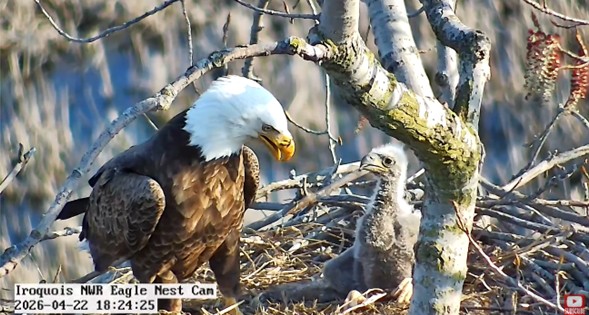
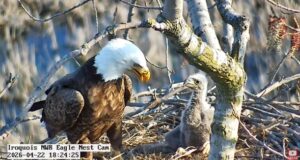
The eaglet who is the focus of the Iroquois refuge’s nest camera has been growing by leaps and bounds. (Courtesy of Pixcams, Inc.)
The baby eaglet that’s in focus at Iroquois National Wildlife Refuge is now over two weeks old, is getting a lot bigger and is entertaining nest cam watchers with its antics.
The eaglet is in a nest that belongs to one of several nesting pairs of bald eagles at Iroquois National Wildlife Refuge, on the border of Genesee and Orleans counties. The nest camera was put in place and is maintained by Friends of Iroquois National Wildlife Refuge, with the help of Pixcams, Inc., Treeman Tom and others.
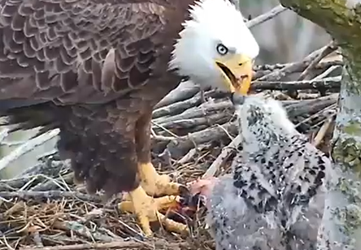
The chick is standing upright more often and using its wings to move itself around and balance. It is much more aware of its surroundings and now reliably tracks the parents’ movements, approaches them for food and grabs it from them directly instead of waiting for them to place food in its mouth.
It is taking much bigger bites of food – most often fish, including a lot of carp ─ and eating larger, less frequent meals (separated by hours-long food comas!). You can usually see its visibly full crop.
The eaglet’s first wispy white down is being replaced by a more insulated grey thermal down so it can thermoregulate better and no longer needs to be incubated as intensively. You can sometimes see the father eagle, especially, since he’s the smaller parent, struggling to stuff the chick under him to brood. The chick is also doing some practice preening as its new feathers come in.
On these warmer days the parents have been leaving the chick alone in the nest for longer periods of time. When they aren’t on the nest at least one of them is usually on guard nearby. So if viewers are seeing the parents gone for longer now, this is normal. The chick is much more independent and the adults are still out there guarding against predators and intruders.
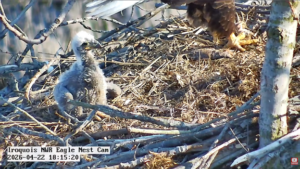
The Iroquois refuge eaglet is standing on its own better and is getting more independent. (Courtesy of Pixcams, Inc.)
The chick’s antics have included a “Lady and the Tramp” moment when the mother eagle had one end of a string of duck intestine and the chick had the other. To see moments like these, tune in the nest cam streaming through the link at FINWR.org.
A quick recap, for those who may not have been following along: Our eagle parents laid three eggs at the end of February and they hatched the first week of April. Unfortunately, two of the chicks died due to accidents in the nest. But that has left the middle chick, the one that survived, as the sole focus of mother and father and ─ without any competition ─ the recipient of an enormous amount of fish bits.
The chick’s flight feathers are beginning to emerge. In the next few weeks, it will develop more substantial feather growth on its head and back and will take on more of an “awkward teenager” look, and the parents will spend even less time brooding.
Around 5 to 6 weeks, the chick will start to stand more steadily and will begin wing flapping in earnest. At 6 to 8 weeks, the eaglet will get very large, almost adult sized. At 8 to 10 weeks – the end of May and beginning of June ─ it should be feathered enough to look like a dark juvenile bald eagle, and its first few unsteady flights might begin by mid-June. The typical fledgling window is 10-12 weeks after hatching. Even 4 to 6 weeks after fledging, roughly mid-July, the eaglet will still be dependent on its parents for food and flight training.
If all goes well, by late summer or early fall the chick will be a full juvenile and out on its own, but it won’t develop its white head and tail feathers until it’s 4 to 5 years old.
This article was a collaboration of Friends of Iroquois National Wildlife Refuge members Richard Moss, Emma DeLeon, Amy Merritt and Garner Light. If you have a bald eagle question for the team, send it to Richard Moss at heron@finwr.org and we may answer it in a future release.