

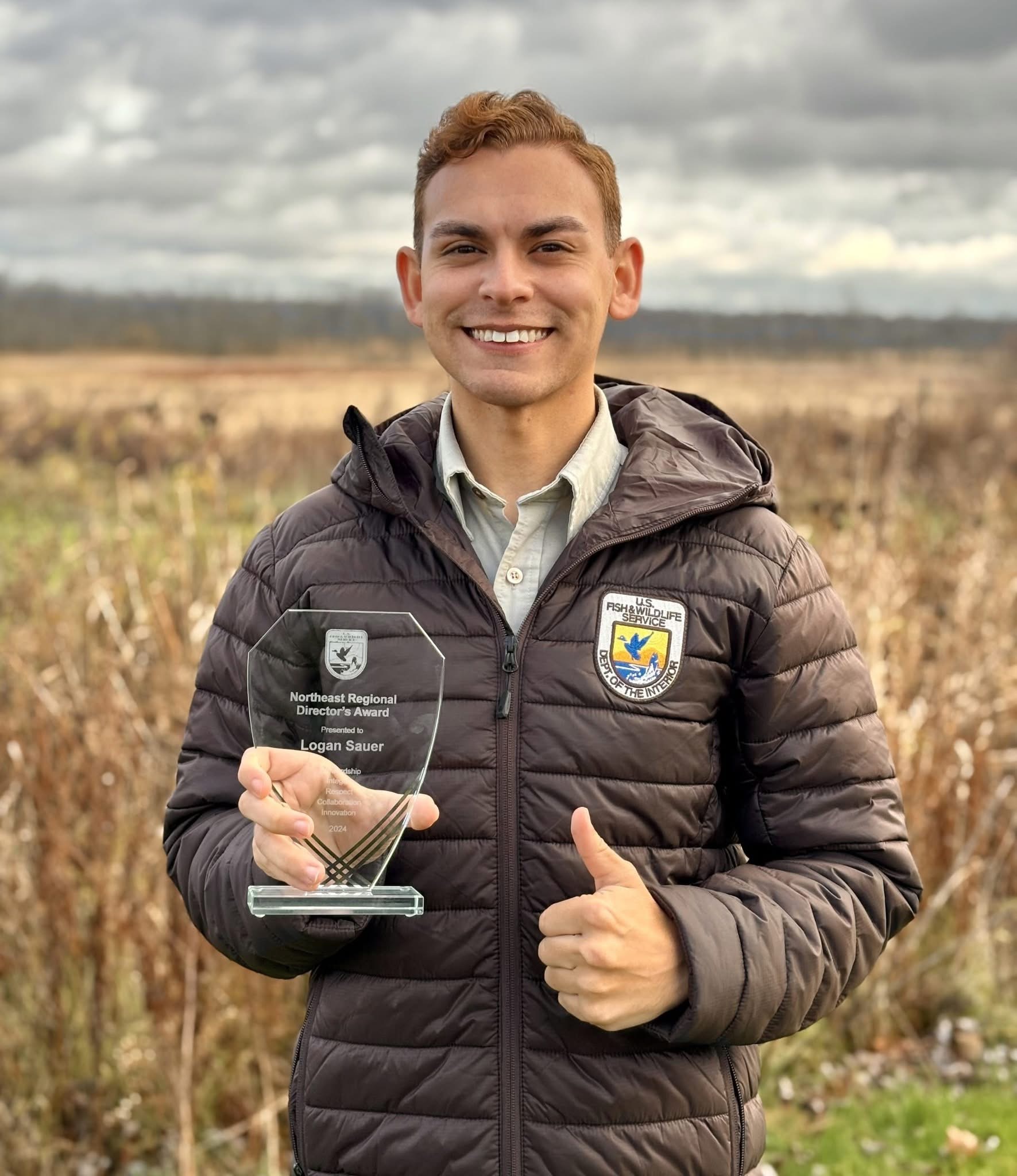
Ranger Logan Sauer and the Connecting People to Nature Award he received at the 2024 U.S. Fish and Wildlife Service Northeast Regional Director’s Award Ceremony.
By Patti Singer
Logan Sauer spent summers in his middle-school years roaming the forest near his Virginia apartment complex with his friends, collecting rocks and holding frogs. He’d go on hikes with his mom, but mostly on paved trails.
“We weren’t really outdoorsy people,” said the 28-year-old visitor services manager at Iroquois National Wildlife Refuge.
But he watched plenty of Animal Planet and sat enthralled through episodes of Bob Ross’ The Joy of Painting. He excelled in his high school science and art classes. The summer after graduation, having just turned 18, he worked in the Youth Conversation Corps at the Potomac River National Wildlife Refuge, about 20 miles from his home.
“I was like, ‘I can do this as a job?’” he said. “I didn’t know that was a career path. The people running the wildlife refuge were very inspirational and wanted to help build up the next generation of conservation leaders. I still talk to them. Without them, I don’t think I’d be at this wildlife refuge.”
Sauer is the ranger that visitors to Iroquois National Wildlife Refuge are most likely to meet. He’s already been recognized by his peers for his outreach on behalf of the refuge. He received the Connecting People to Nature Award at the 2024 U.S. Fish and Wildlife Service Northeast Regional Director’s Award Ceremony. He has increased the number of people reached by programs at Iroquois, and the diversity of those being served. He works with young people in underserved communities and by advocating for equitable access to public lands for recreation. His efforts help to inspire and develop the next generation of conservationists.
Acknowledging his nontraditional path to being a park ranger, Sauer uses his love of art to invite others outside. He wrote on his LinkedIn profile that he is passionate about connecting people to nature through art.
“Not many park rangers did that,” said Sauer. “Most park rangers have the same background. I wanted to offer something different and stand out in the crowd.”
Paint-and-sip
After graduating from the University of Maine in 2019, he took a seasonal internship at Moosehorn National Wildlife Refuge along the north coast of Maine. He asked his boss if he could host a paint-and-sip, where people would create art and enjoy mocktails.
“He was skeptical,” Sauer recalled.
Thirty people in the rural community — including his boss — showed up to paint scenes of the night sky.
“That launched my art and conservation career.”
Connecting through art
Sauer knows that the same people who hesitate to explore nature may feel intimidated by a paintbrush.
“When I’m advertising for our paint program and someone will say, ‘I don’t know how to paint,’ I say this is the class for you. It’s step by step. I’m working with you. … Everyone produces something beautiful.”
Sauer took an internship at Ottawa National Wildlife Refuge in Ohio a month before COVID hit. Unable to host in-person events, Sauer created a YouTube video on how to paint a wetland scene.
When he secured his first permanent federal job in December 2020 as park ranger at Minnesota Valley National Wildlife Refuge in Bloomington, his job was to connect communities through art.
Working with artists and art nonprofits made him think of himself as an artist, too. “I was telling them about my work. They made me feel included in the art community.”
Sauer brought that feeling to Iroquois National Wildlife Refuge. A volunteer leads the art classes now, but Sauer substitutes on occasion. Much of his time is dedicated to being the liaison between the refuge and the western New York community.
Outreach programs
Among his programs is the Buffalo Urban Wildlife Conservation Partnership, which provides youth with recreational opportunities either in their communities or at the refuge. He also worked with a student in Kenmore on painting a mural for a community garden.
Often, the outreach is an opportunity to promote conservation as a way of life or as a career. “Just getting them out into nature and appreciating nearby green space in any capacity is the goal.”
His killer biko
Away from the refuge, Sauer keeps up with his art, plays tennis, tries new restaurants and cooks. He incorporates his Filipino culture into his specialty — the traditional sweet rice dessert called biko. “It takes a lot of patience to cook. I do have that patience because I want it to be good.”
But don’t take his word for it.
“Here in western New York and where I was in Minnesota, the aunts of the Filipino community say I have the best biko. I take that everywhere.”
Writer Patti Singer is a retired reporter for the Rochester Democrat and Chronicle.